Every encounter, coded before you sign
Curis reads the visit as it happens and proposes the codes that belong to it — with the score and the evidence for each one, so nothing goes out on trust alone.
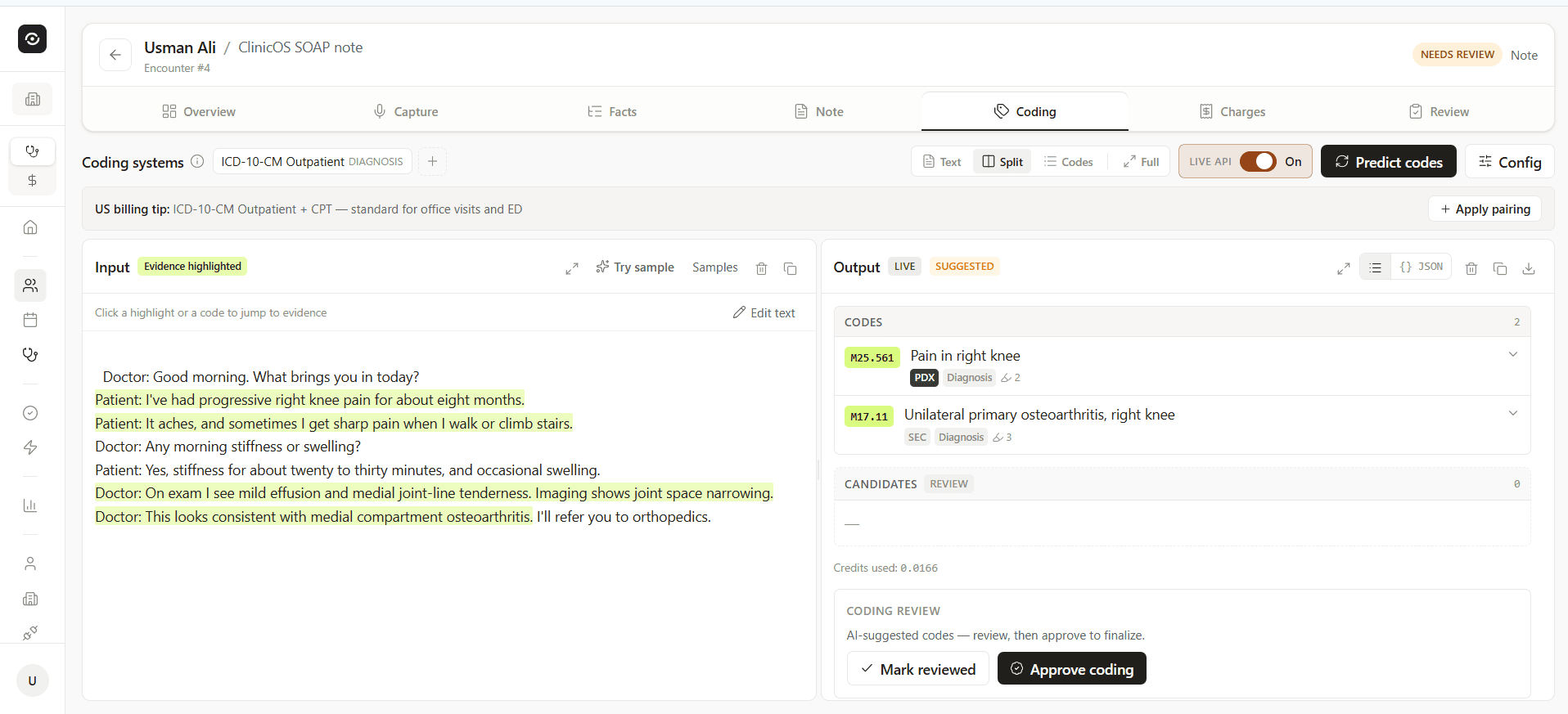
Swipe the screenshot to see the full workspace.
Evidence highlighted
Every proposed code traces back to the words in the transcript that support it.
PDx & SEC
Primary and secondary diagnoses marked the way your biller expects them sequenced.
Live API on
Coding runs while the visit is still open, not on an overnight batch.
Approve to finalize
Suggestions become claims only after a coder or clinician signs off on them.
You decide how much the model is allowed to decide
Every suggestion carries a score. Above your threshold, the code is submitted. Below it, the encounter lands in a review queue with the reasoning attached — so your coders spend their time on the cases that actually need judgement.
Held for review
0 – 69
Coder glance
70 – 89
Auto-accepted
90 – 100
Measured against your own coders
- 97.4%
- Agreement with the final coded chart
- 88%
- Of encounters cleared with no review
- 4.2 hrs
- Clinician time returned each week
- 0.9%
- Of suggestions corrected on appeal
Full ICD-10-CM, weighted by what you actually see
Trained on de-identified encounters across primary care and multi-specialty. The chapter mix below is from live practices, not a benchmark set.
What it refuses to guess
A coding model is only trustworthy if you can predict where it stops. These are the edges.
It will not code a diagnosis that is not documented
If the encounter does not support a code, Curis proposes nothing rather than inferring from history alone.
It will not sharpen a vague code by guessing
When specificity is missing — laterality, encounter type, sequelae — it asks the one question that would resolve it.
It will not hold back a low-confidence code silently
Anything under your threshold is shown in the review queue with its score. Nothing is dropped.
It will not train on your data
Corrections improve your tenant only. Encounter data never enters a shared or public model.
No card · 14-day trial
Send us a week of de-identified visits
We will return the codes Curis would have submitted and the ones it would have held back — with the scores — before you commit to anything.